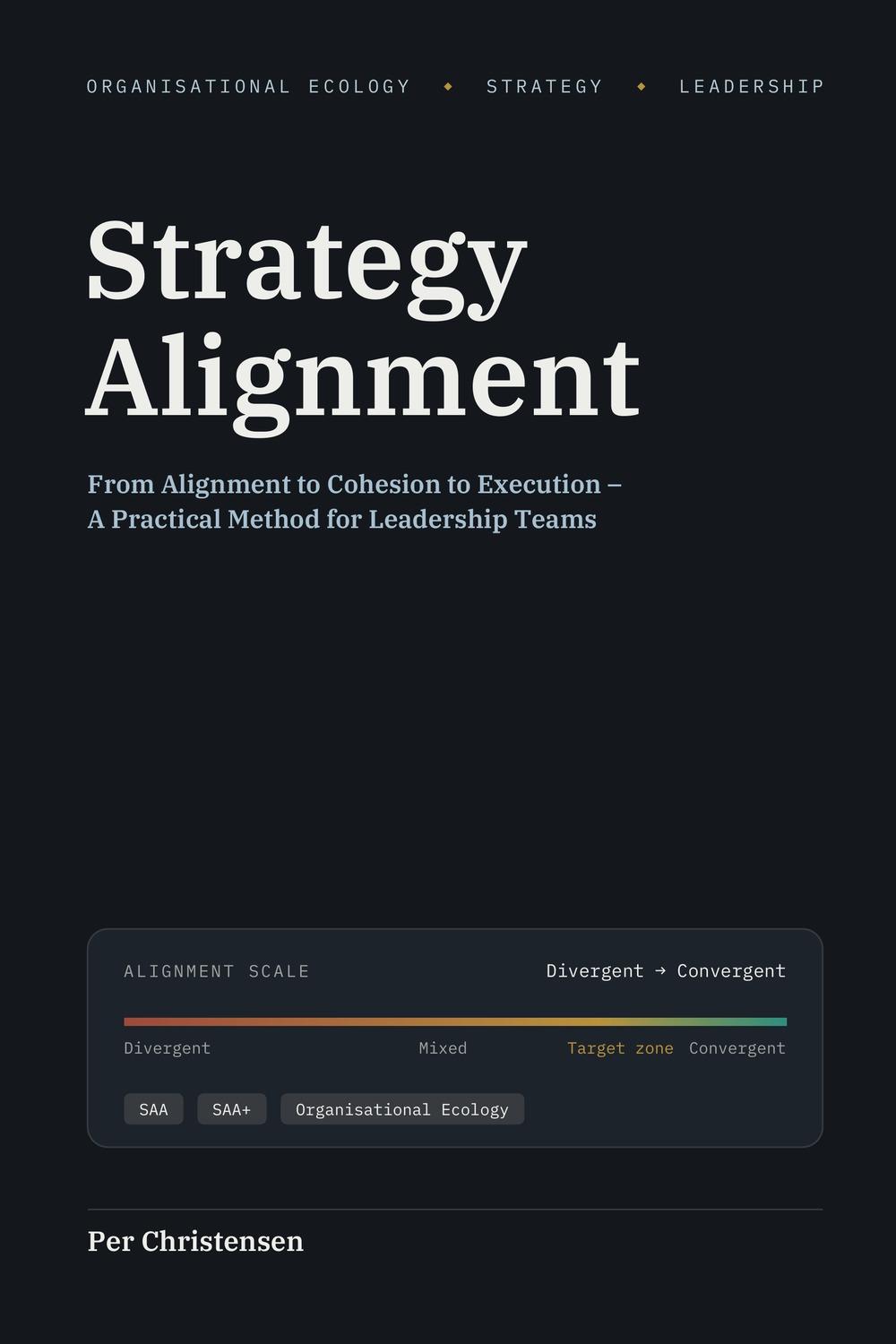
Strategy Alignment
From Alignment to Cohesion to Execution - A Practical Method for Leadership Teams
Published October 11, 2026
Does your leadership team really agree on what matters most?
Most leadership teams believe they share priorities. Few have ever checked. Ask each member to rank the organisation's goals and the finance director puts the financial goal first, the sales director the market, the head of HR competence and working environment. Each is surprised the others have done the same.
Nothing is wrong with any of those rankings. Trouble starts when a team does not know they differ. Decisions stall, action plans weaken, and the strategy exists on paper but not in practice.
Strategy Alignment shows how to close that gap. Per Christensen brings together two strands of work:
Organisational Ecology is a practical theory of organisational change, developed since 1988. It explains why well-intentioned people who all want the organisation to succeed so often pull in different directions.
Strategy Alignment Analysis™ (SAA) is a structured method that measures how aligned a leadership or project team is on its strategic focus areas, then helps the team turn that picture into cohesion and execution.
The theory gives the measurement its meaning, and the method puts the theory to work.
You will learn:
Why organisations are better understood as ecosystems than as machines, and why short-term fixes so often produce long-term side effects
The nine organisational-ecological principles for change
How positions, perception and language shape what people agree on, and what they only seem to agree on
Why resistance to change is feedback, not opposition
The difference between alignment, which can be measured, and cohesion, which must be built
How the eight steps of an SAA work, from choosing the focus areas to the workshop where the team works through its results
How the SAA+ framework links vision, strategic focus areas, goals and action plans, and how to follow them through
Where measurement reaches its limits, and the ethics and confidentiality responsible use demands
What makes this book different
It does not offer a quick fix. It argues that differences in priorities are natural and, up to a point, valuable, and that a team which can see its own alignment clearly is better placed to strengthen it. Because the differences are quantified, the conversation stays factual rather than personal. SAA measures how closely a team's priorities align, never the quality or performance of an individual.
The book includes a worked case of nine leaders and five focus areas, plus anonymised examples from real consulting work. The algorithm behind the Alignment Index is proprietary and not described. The book explains what the measurement captures, how to read the results and act on them.
Who it is for
Leaders and board members who are responsible for a strategy and want it to become more than a document
Consultants, organisational developers and advisers who help leadership teams with strategy and change
Students of strategy, leadership and organisational development
Sixteen chapters in five parts move from the problem, through the theory, to practice and execution. Each chapter ends with reflection questions, and the book closes with notes, a glossary and a bibliography.
 Read a sample on Amazon